Showing posts with label Failed Healings. Show all posts

Saturday, August 01, 2020

The Poverty of Prosperity Teaching

After the depressing series I've run on Bethel supremo Bill Johnson I thought I would end the series on a positive note: Well sort of....

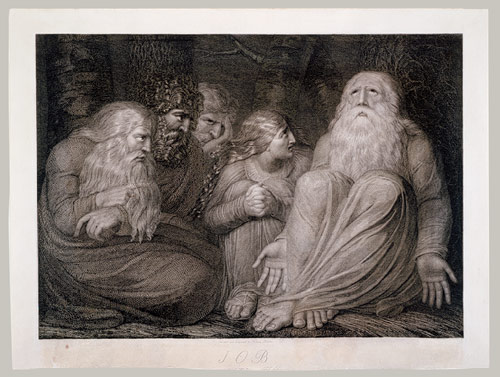
Job and his "comforters"; Job's suffering didn't last but like all suffering,
when you are in it, it lasts too long!

As if to dispel any doubt that Premier Christianity  Magazine eschews the prosperity gospel we find an article in the July edition by the editor Sam Hailes entitled  "I was is in constant agony". At the very start of the article we read:

Eric Gaudion's story is an affront to the prosperity gospel. It contradicts the misguided belief that Christians don't get sick. It challenges those who guarantee your healing - if only you pray harder, obey more or have more faith.

Hailes then goes on to relate the story of Christian Eric Gaudion, a  Pentecostal minister afflicted for 22 years with acute haemorrhaging pancreatitis. As a Pentecostal he had no a priori principles which impeded him seeking and believing in prayer for miraculous healing, but....

...nothing seemed to work. "I had so much oil poured on my head I wonder that my hair ever dried!"

Instead Guadion had years and years of terrible pain and once very nearly died in the intensive care unit. There was psychological trauma too, for himself and his family. He was also tormented by Job's comforters...

...telling him to "pray about it" asking "Where's your faith" or even suggesting he'd been cursed. [These] were all examples of how poor theology can magnify a person's suffering. "The very worst was claiming I'd been demonised" Gaudion says.

Tell me about it! I once met a Christian schizophrenic who was told that he was in bondage to the demonic and he should have an exorcism! I'm really ashamed of many evangelical Christians with their crackpot superstitions and that's before we get to the Trump supporting Christians with their Covid 19 denying, conspiracy theory pushing and gun toting anti-establishmentarianism. As with Bill Johnson, if something doesn't quite go the way they want or expect they witch hunt until they find someone to blame. 

But then in 2017 the medical profession came up trumps. Gaudion had a risky operation that had only been done once before. In fact it was so experimental that the BBC filmed the 16hr operation. The procedure  would....

... remove his pancreas and transplant the islets that produce insulin in the liver.

It worked:

"I'm completely free. I'm no longer on opiates. I have no pain. I thank God that my life has been transformed". 

The article says that Gaudion has written a book about his journey, a book which grapples with the theology of suffering: It's titled: "Through Storms: A manual for when life hurts". The article in Christianity finishes with a final comment from Gaudion himself (alluding to Covid 19):

We're facing a massive loss and grief and I feel God's heart is with us in that grieving process; that he weeps over the losses and shares with us in the pain of all that's happening. We also know our God is a redeeming God. And he longs to work even in crises like this, to redeem, to restore, to rebuild and, ultimately to bring us through. 

As a rule I don't comment on the question of suffering and evil (I've really only ever done one article on the subject) as so much ink has been spilt on the subject already and in any case I feel that people like Gaudion are far better qualified to speak about it. Gaudion's story is challenging and humbling: Could I go through with that kind of suffering and successfully come out the other end? I'm afraid to say that I really don't think I'm made of that kind of heroic stuff, but it's good to know that some people are.

As I have said more than once, credit must go to Premier Christianity for their honest, candid and courageous publishing, especially as so much evangelicalism is in the grip of triumphalism, superficiality, self-deceiving sophistry and a distinct lack of intellectual integrity. I have at times complained about some of Christianity's occasional writers but I think I can say that on the whole we are dealing with an honest editorial team that doesn't overlook tricky issues and faces them square on. But otherwise there is a large swathe of evangelicalism badly in need of a challenge to its spiritual complacency, cloud cuckoo land fundamentalism, irrational fideism, elitist gnosticism and above all its selective gullibility.

Gaudion's story is a fitting end to my series on the self-deceiving spiritual spin of Bill Johnson.

***

For the previous parts see:


Tuesday, June 23, 2020

Prosperity Christianity Part V: Soft-cop theologian examines Bethel Biblically.


Mike Winger Soft Cops Bill Johnson. 

For the previous parts see:


The above video is an analysis of the Bethel movement by Mike Winger. He himself is a charismatic and is no enemy of Signs and Wonders per se. He's also generous toward Bethelism and doesn't deny that some of Bethel's teaching can inspire. I would call him a "soft-cop"; in fact some of the comments in the YouTube comments thread suggest he's too generous. But having listened to Winger I can only say that if Winger is a soft-cop then just how hard are those hard cops? I'll move onto a hard cop later on, but really who needs hard cops when we've got Mike Winger's devastating points of criticism! I would, nevertheless,  recommend Winger's video to anyone wanting to find out more about Bethelism. On second thoughts I think he's a "fair cop"!

Winger's Verdict
The following is my interpretation of some of Winger's salient points. This interpretation can be checked by looking at the video. [I have put my own additions in square brackets] 

Winger says he's watched 60hrs of Bethel video footage to come to his conclusions. He doesn't accept that they are a front for shadowy demonic influences and believes that Bill Johnson and his lieutenant Kris Valloton are Christians. He even accepts that real healings do come out of this movement. But he believes there is a lot of fake stuff coming out of it as well. He says that Bill Johnson's vision for Bethel is that of spear heading a world wide movement. Through what they claim to be an apostolic network they aim to bring revival to the world wide church after the image of their own concept of revival. Johnson believes this revival will come by proactively exporting their "Jesus culture". [It's true that the Bethel influence has popped up all over place!]

But Winger sees a mixed bag. He sees twisted theology, a theology which encourages its followers to be fake and to fake healings and prophecies. Johnson's followers call him an apostle although he never makes use of that title himself; but he doesn't stop his followers thinking of him as such.  [The "apostles" of the circa 1980s "Restoration" movement  adopted a very similar coy-strategy to their apostleship] 

Winger shows a clip where it appears that Johnson is saying that "teaching" has less to do with Biblical text than it does in having an apostle as a channel of teaching. He thus subtly shifts the disciples attention away from Scripture to the apostolic figure himself and his authoritative teaching. [Hence, the cut, thrust and ongoing contention of Biblically based argumentation is supplanted by the authoritative quietus imposed by the apostle, where the apostle is almost a kind of embodiment of the Word.... clearly a dangerous precedent given that only Christ himself has claim to the title of being the Word]

On healing Johnson becomes even more extreme: Using Galatians 1 & 2 he informs us that anyone who doesn't accept Johnson's claim that all must be healed is in effect teaching a different gospel! Johnson talks about Jesus being "perfect theology" which for him means we simply must follow Jesus' practices and in a literal sense do as Jesus did: To this end Johnson resolves the resultant contradictions with scripture by constructing a doctrine of "Truth priorities": For Johnson some things in scripture are true but other things are "truer". His lesser truth category means that Johnson can ignore or override, for example, the tribulations of Job in favour of his "Jesus is perfect theology" prosperity Gospel. [Johnson neglects the fact it is still our responsibility to interpret the meaning of Christ's life and therefore we can make no claim to having in our hands "perfect theology" when we study and follow Christ]

To further justify Bethel's prosperity teaching Johnson uses the argument that "God can't give what he doesn't have". Therefore God can only impart health and wealth because He only  has health and wealth - i.e. he doesn't have poverty and ill health. e.g. God doesn't have cancer therefore he won't give you cancer. Consequently Christians must be rich and healthy. Winger calls this shallow theology.  (And see Rev 2:22-23).  But did Jesus really teach a prosperity Gospel? Johnson uses Mat 6:10 to justify his position, but Winger says that this verse only finally applies in the fullness of time when there is, eventually, no death (See Rev. 21:4). In contrast Chris Volloton has said "No one in our congregation is allowed to die except of old age". So says Winger, Vollonton accepts that death does eventually come to Bethelites and therefore Mat 6:10 doesn't, after all, hold at Bethel! 

At Bethel it feels as though there are a lot of healings taking place. But they get round the fact that healing doesn't always happen by poor confirmation of healing and using a doctrine of "keeping your healing"; that is, if your symptoms come back you are told that you are "losing your healing" which then triggers a process of spiritual investigation & diagnosis as to why the healing hasn't taken. They also talk about "the fragility of the anointing": Bill Johnson's son has a hearing problem which hasn't been healed. Once again Johnson finds an excuse to ignore this glaring inconsistency: He says that it will ruin his own anointing if he thinks with critical awareness about this inconsistency. Hence there is pressure at Bethel to avoid thinking about negative outcomes because if you do then Johnson's says it may badly effect your anointing. Bethel, therefore, have many ways of explaining away and/or coping with apparent failures of healing and this includes encouragement to turn a blind eye if no spiritual explanation is available .[In effect Johnson is proactively barring intellectual integrity as a harmful influence on their fellowship; hence a gullible unquestioning idiocy is actively encouraged at Bethel - Idiots for Christ!] 

For Bill Johnson's Bethel any nice and positive sounding words that someone feels they should say are liable to be ranked as prophecy; but only positive, happy words are allowed. Negative prophecies are banned at Bethel.  Hence Bethel becomes the source of many fake prophecies. Bethel also has such a thing as "Destiny cards" which are suspiciously like Tarot cards. 

Bethel are trying to engineer a revival in their own image. They are a contrived movement. 

So that finishes with Winger's assessment. I now want move on to.....ressurection.


A Prayer for Resurrection
The ethos of unwillingness to face the tricky realities of Christian life with critical awareness recently had a very sad nemesis at Bethel. In a very public display the Bethel fellowship prayed fervently for the resurrection of the deceased daughter of one of their worship leaders. The matter was reported in a news item in the February 2020 of Premier Christianity magazine. But the affair also got a wide airing in the secular media; the full glare of public attention as the magazine puts it. The Christianity article tells us how for several nights Bethel held services where they implored God for a resurrection, but after a week they faced the heart-breaking and tragic reality of the infant's death. 

The article quotes Johnson's well known position on healing, a position which is based on the notion that Christ's sacrificial death has already "purchased healing" (A common theological cliche among prosperity healers),  a position that encourages a witch-hunt seeking spiritual pathology should God not deliver (My emphases):

"When he bore our stripes in His body He made a payment for our miracle. He already decided to heal. You can't decide not to buy something after you've already bought it.....All lack is on our end of the equation". 

Well, that tells us where Johnson is going to look for spiritual failure when his prosperity expectations aren't fulfilled!  And I don't think Johnson is the sort of guy who is just going to tell us that his church was merely trying to be obedient to Christ's command to raise the dead (Mat 10:8) as Christianity quotes him, and then leave it at that. No, rather than just shrugging his shoulders Johnson looks like a man who is going to angle for a source of blame. But one thing you can't accuse these Bethelites of and that is a lack of belief. So where is Johnson's theological logic going to take him?  Perhaps he'll blame those Christians who criticise his "perfect theology"? After all, those who criticise his prosperity line on healing will, according to Johnson,  be teaching another gospel!

But undaunted by Johnson's theologically threatening position Christianity magazine, partly through the mouths of various pundits, arrays a strong critique of Johnson and Bethel. It is in great contrast to the Christianity article I quoted in part I where the reporter seems to be a Johnson convert. In this latest article, however, we hear that: 

The episode was grounded in really poor theology....you just take little snapshots of the Bible and pick out phrases here and there to extrapolate these huge expectations to command how God should act in a situation......they were praying for only one possible outcome...A wise pastor would stand with the bereaved parents while also gently sharing that God may have other plans as well.....Many evangelical writers have expressed similar concerns....Bethel's theology results of a transactional view of God....God is seen as a genie who will always say yes to our requests if we just say the magic formula.....my anxiety is around the mental health of the parents and the wider community when the miracle was not forth coming.

But Johnson takes no responsibility for the event. He says that they...

...had no option but to ask for resurrection, because that was what Jesus commanded his disciples to seek after.

...and remember if you don't accept Johnson's view without qualification then you may be accused of  preaching another gospel!

Christianity magazine tries put a brave face on it along and the best gloss. The hope was that....

....this story would encourage small churches to pray for healing miracles not out of habit but in the hope that God may actually act....all Christians should trust God enough to ask for big outlandish miracles even if they don't happen.

I doubt it: More like it will make Christians wary of such public failure. The Christianity article still talks about "the struggle against the giant of unbelief". I don't see any unbelief at Bethel (although I do see a lot of gullibility). Talk like this will only create more unresolved conflict, loss of confidence, heart searching and guilt in the lives of believers about their "lack of faith". Pray for healings and miracles by all means but don't think they are a reward for faith and if they don't happen don't then embark on a witch hunt for a lack of faith and/or spiritual failure somewhere. So in spite of starting well, in the final analysis  the Christianity article falls down badly, yet again.


The Hard Cop
We find our really hard cop on this web site:

http://watchman4wales.blogspot.com/search/label/Bill%20Johnson

Now I'm not sure I would want to meet this guy in a dark alley because he would likely hard-cop me and accuse me of heresy as soon as look at me. But then Bill Johnson, as we have seen, is himself a hard cop who is likely to tell us we are preaching another gospel if we don't tow his line on healing. One hard cop deserves another! So here we go with our stern Watchman4Wales' verdict on Bethel and the Johnsons:

It is important to note that the Ffald-y-Brenin bookshop is also very well-stocked with the works of Bill and Beni Johnson, the Senior Pastors of Bethel "Church" in Redding, California. This has to be one of the unsafest "Christian" couples on the planet, their "Christianity" having all the authenticity of a paste diamond, with Bethel having far more in common with sorcery and New Age mystical spirituality than with Biblical Christianity. From gold dust to glory clouds, from falling feathers to fire tunnels, from floating orbs to a born-again "Jesus," from waking up sleeping angels to grave-sucking necromancy, absolutely anything goes at Bethel under the Johnsons' (mis)leadership.

The Ffald-y-Brenin bookshop can thus lamentably be seen to be recklessly disseminating to the unsuspecting an alternative form of faith that is assuredly NOT the true Faith, but instead a deeply fallacious mystical New Age delusion, a cunning counterfeit of Biblical Christianity inspired not by the Holy Spirit but by a subtle and seducing utterly unclean spirit, working stealthily out of the war-camp of the Enemy!

To back up the charges of necromancy we are provided with pictures of "grave-sucking". Below I  include these pictures with their captions: 

And here's Beni Johnson herself, soaking up the anointing of  C.S. Lewis's bones by lying on his grave in Oxford. She also uses a 528HZ tuning fork for prophetic purposes...


A group of students from Bill Johnson's Bethel School of the Supernatural engage in sucking up Evan Roberts' anointing from his grave at Loughor in South Wales...

Hard copping done! Need I say more? 


Summing Up
Large swathes of Christian culture lack intellectual integrity. In fact I've long since come to terms with the fact that Christianity as a faith is extremely idiot proof - that is, it has a high resilience to the large numbers of gullible idiots (some of whom actually classify as malign idiots) who enter the faith. But in spite of taking onboard hoards of these idiots the integrity and dignity of Christianity's high sounding cosmic message of salvation is no more compromised than is the majesty of deep space in the presence of a few deluded "grave suckers" who inhabit one small corner of the cosmos. If I didn't believe this there would be no Christian faith for me (See here and here). In fact the only other (intolerable) alternative to the Open Gospel would be to join one of Christianity's  mean  little "holy remnants"  of huddled Christian crazies who think of themselves and their sect as the one and only true church and all others to be potentially demonic. Like Winger I don't believe Bethel are demonic but they do have a high density of gullible stupidity in their ranks, a stupidity which allows people like Johnson and Valloton to peddle their prosperity gospel justified as it is by a shallow, muddled and incoherent "quip theology".


Stay comatose!
As we have seen in this series Johnson's strategy is to do what he can to block any self reflecting & self critical stance, a stance which is liable to endanger the Bethelist philosophy of comatose forgetfulness. Critical-think, Johnson effectively warns, may lead to the loss of your all-important "anointing". Any apparent inconsistencies of Johnson's philosophy with scripture are dealt with by a doctrine which ranks and prioritises truths so that some truths can be regarded as overriding other truths. (Winger rightly identifies this notion as gobbledegook). As Winger says Johnson has therefore found ways of preventing scripture as a whole of correcting his contention that Jesus' life entails a prosperity gospel. This prosperity gospel, according to Winger, flies in the face of Job.  The ultimate backstop to critical thought is found in the notion that apostles are a kind of incarnation of scriptural teaching. Hence when the chips are down they can pull out this authoritarian card in order to further help ease through their theology. A claim to authority is the ultimate device to stultify a Berean assault on Johnsonianism. This is, however, not an original strategy: I remember reading the restorationist Arthur Wallis where he claimed that the chief way restorationist leaders exert their authority is via their Bible teaching. Thus, in effect  they claim a special almost priestly right to interpret scripture authoritatively (for more on restorationism see here).

At one point in his video Winger remarks on how Bethel teachers teach in a cheeky humorous way. This can be seen with other popular teachers of this ilk; see here. A brash humorous quip theology has great folk appeal.

All in all Bethel have contrived plenty of auxiliary hypotheses for explaining away failed miracles and stopping critical analysis of this failure in its tracks. Let us recall, however, that Bethel is a highly predatory sect determined to stamp their image on the rest of Christianity: They are pulling out all the stops to spread Johnson's teaching. But they may now have pulled out one stop too many.  Like the Restorationism of circa 1980 its empire building appeal will eventually peter out. 


Note:

Wednesday, September 11, 2019

In Search of Spiritual Fireworks


I've complemented Premier Christianity magazine on its mix of articles before: It doesn't present a plastic, sanitised or sectarian Christianity but instead an authentic version with all its warts, messy contradictions, unresolved questions and raw tensions. So if it's going to be representative of the true state of Christian affairs then along with what to me is agreeable I would expect to find articles by commentators that I wouldn't necessarily see eye to eye with; for example it has recently published another article by the fundamentalist leaning R T Kendall (See here for an earlier article). But even in Kendall's article we find him candid and up front about one significant aspect of Christianity as we shall see.

The article in question appears in the September 2019 edition of Christianity and is entitled Word vs Spirit. As I suggested in my earlier blog post Kendall is a dualist and probably a "gnostic" dualist at that;  that is, he sees Christian conversion only rightfully completed if one has gone through some kind  initiation into the "deeper things of the Spirit". In my previous post on Kendall  I quoted a certain Jonathan Hunt (Hunt seems to be associated with the conservative evangelical Metropolitan Tabernacle) who comments on Westminster Chapel in the days of R T Kendall's tenure (See here):

The sad decline of Westminster Chapel into the charismatic extremes of today was begun even then. (See the Rev Iain Murray’s comments upon RT Kendall’s ministry here)

Although this quote comes from a rather sectarian source and must be treated with caution*** it is evidence of Kendall's charismatic credentials. Given this background it is no surprise that in the current article we find Kendall taking it for granted that there exist "Word" and "Spirit" versions of Christianity which fall into quite distinct categories: For him one can major in "Word "Christianity and minor in "Spirit" Christianity or alternately one can major in "Spirit" Christianity and minor in "Word" Christianity. His desire is that this dichotomy is resolved.  But is it really such a clear dichotomy as Kendall makes out?

***

As in my first article on Kendall we find him once again casting aspersions on the church for its failure to live up to his expectations. His expectations are in fact predicated on his world view, a world view which filters his observations through a Word vs Spirit polariser. In his mind the church is culpable for not bringing together Word and Spirit. To solve the problem we must...

...all see the urgent need  for both Word and Spirit to come together as in the book of Acts. 

As is so often the wont of stern evangelicals like Kendall, he is not the kind of guy who minces his words about what he identifies as sin in need of repentance:

Those who read this (i.e Kendall's words) may - just may - be gripped to lament and repent over our situation and intelligently pray that the honour of God's name which has long been behind a cloud will be restored....there is no fear of God in the land or in the church....we are in a deep deep sleep with little or no expectancy and no great concern  or outrage over the conditions around us

Kendall has a low opinion of both Word centred and Spirit centred Christians :

Those [Spirit] people who run to church because they know they will be riveted by exciting and fearless preaching are hard to find. So much of what comes from Word pulpits  is "perfectly orthodox perfectly useless" as Dr Martyn Lloyd-Jones used to say. 

For Kendall large swathes of the Church are in the doldrums of an utter uselessness. People who love the Word are not seeking power and people who love the power of the Spirit are not seeking the Word.

But what does Kendall mean by power? To this end he alludes to the signs, wonders and miracles in the book of Acts. Fair enough; a few restored amputated legs, the raising of the certifiably dead, authentic prophecies and miraculous insights etc would be a welcome manifestation of divine power.  (Although Kendall doesn't mention miracles of revival where there is seemingly inexplicably rampart conversion in response to preaching). Things like this are measurably hard evidence of God's paranormal power.  But in a candid admission Kendall tells us that this kind of thing is exceedingly rare:

I believe many need to hear this message - myself included. I long to preach with power and authority. I personally experienced that kind of power and authority only once or twice so far in my lifetime. I have seen some miracles and healings over the years but very few. True miracles and verifiable healings are exceedingly rare. 

Well at least Kendall has got something right; we see very little overt evidence of divine paranormal power.  So why this dearth of miracles and conversion avalanches? But Kendall thinks he knows the answer to that: He blames their absence on church people who have failed to address his dichotomy. Yes, he's that kind guy and his message of a lack of faith, expectancy and failure is common in charismatic churches who seek to rationalise and explain away the absence of what their version of Christianity leads them to expect. In an inversion of Peter Abelard* one can hear sentiments very similar to the following among Charismatic  leaders:

How many times have you said, “I’ll believe it when I see it!” That’s the traditional approach, based on the ability to tangibly see things to know they exist. But from a spiritual level, we want to switch that around. The Truth principle is this: I’ll see it when I believe it! This means we see it with our spiritual eyes, before it actually manifests in the real world.

This kind of philosophy provides a ready means of explaining away crushed expectations by apportioning blame for lack of faith. In practice what "I’ll see it when I believe it! " really means is "I'd better believe it when I first hear it from my spiritual guides".  What's being asked for here is that the "evidence" planted in the ears by the these guides should not be the subject of observation and critical analysis. "Don't analyses it" is a phrase that has been used by Ellie Mumford about the notorious Canadian Toronto Blessing. These epistemic attitudes disenfranchise the Christian's intellect and encourages the notion that a sheer teeth gritting belief is what is needed to conjure up the miraculous when the evidence, apart from the vehement assertions of one's spiritual guides, simply isn't there. When the promised miracles fail to materialise then the explanation that there is someone out there with deficient faith who is to blame is likely to cause bitter disappointment, recriminations, angry backbiting and division; when what they are hoping for and expecting doesn't come about a witch hunt may ensue as they seek for whoever is stultifying the power of the Spirit. What these people are unlikely to accept is that manifestations of divine paranormal power are not under the control of human strength of belief and that the appearance of this power is probably humanly inscrutable. There are times when divine paranormal power is very overt and other times when it is more covert. Overt measurable displays of paranormal power is an act of divine fiat and does not necessarily have a link with belief, expectation, holiness or prayer because the plan behind it may be beyond our understanding.

Given the bitter recriminations that often follow in the wake of the kind of world view that Kendall promulgates it is no surprise to me why many traditional evangelical "Word" orientated Christians (Such as we see in the Metropolitan Tabernacle quote above) have washed their hands of the likes of Kendall and even go as far as to suggest that overt Pentecostal power is confined to the early days of the New Testament. That may be going a bit too but I'll say this: In my experience many Christians cannot be blamed for a lack of motivation in seeking that the power of God's Word.  As the saying goes the pen is mightier than the sword and seeking sensationalist spiritual fireworks before something is declared to be "in the Spirit " is going to underrate and devalue much of what goes on in churches. Word and power go together; they cannot be separated into distinct Spirit vs Word categories. Sometimes divine paranormal power is overt and sometimes it is covert. But Kendall's dualist world view prompts him to dichotomise sight and sound even though both are active information bearers:

Most of my own preaching over the years - I wish it were not true - has been entirely Word preaching  with little power. When people listened  to me they would say "Thank you for your word". That is what they came for, that is what they got. They did not  come to see anything.; they came to hear.

You can't separate word and power like this: hearing and seeing are both God given senses. Words are never empty and sights always convey a message.

But the absence of hard measurable miracles doesn't mean to say people don't have their own anecdotes of experience of paranormal power; it's just that anecdotal miracles have an epistemic distance which means that only those who directly experience them can imbibe their reality. But for the rest of us the human weaknesses for unreliability, gullibility and confirmation bias can compromise the value of anecdotal testimonies which report on one-off events and erratic phenomena. Kendall simply hasn't  taken into account epistemic distance when he has declared his sweeping write-offs. Instead he embarks on a blame game which has all the potential to trigger off damaging witch hunts and divisions. Moreover, the spurious Spirit vs Word dichotomy can take Christians eye off the ball as they undervalue what they can do, what they see and what they hear and instead merely mark time waiting for enough holiness and prayer to usher in those spiritual fireworks. They then become perfectly useless. Kendall is part of the problem, not part of the solution: He is imposing his dualist categories on the church. No fear of God? Really? Am I really to believe that, say, reformist Christians who are so diligent in their study of the Word have no fear of God?  

Charismatic gurus have a tendency to fall for a version of gnosticism: They cannot identify God's power in the everyday, the prosaic and the common place especially so as the church becomes increasingly marginalised from and irrelevant to the surrounding culture and its learning. So in the absence of measurable paranormal power they turn in on themselves seeking God in the inner life and in inner-light revelations of gnosis. The mass swoon for Jesus events then become the vicarious measure of power and an existential fix for an existential crisis.  But such events are far too close to trance like states and group hysteria to be immediately classified as authentic. One has to be cautious about these "outpourings of the Spirit": They resemble too closely the phenomenon of dancing mania (and also this: https://www.bbc.co.uk/news/world-asia-48850490) for them to be automatically and uncritically classified as authentic. 

Lastly we've got what is very likely going to be another entry in my false prophecy list: 

I truly believe that the Word and the Spirit are going to come together maybe soon. If Smith Wigglesworth has been quoted correctly, we are long overdue to see his 1947 prophecy fulfilled. He reportedly forecast that the Word and the Spirit would come together and that this move would eclipse the Wesleyan and Welsh  revivals and spread all over the world. 

Who knows; we may well see a display of overt divine power, but we won't see a coming together of Word and Spirit simply because it is predicated on the fallacies of a dualist world view. Whilst the activity of the "Power of the Spirit" is registered by dualists only in swoon for Jesus and mass trance  events you can be sure that the polarisation will remain in place; for many people swooning for Jesus  just isn't sympathetic to their personality and rides roughshod over their God given way of appropriating and expressing the faith.  Let us remember that John Wimber's "Third Wave"  never really infused the whole church**; that's in spite of the fact that Wimber's charismatic stance was more intelligent, more conciliatory and more inclusive than other charismatics before or since. The old divided order has reasserted itself probably along cultural and personality fault lines. But in the final analysis this may actually be a good thing: God doesn't keep all his apples in one basket. If one lot of apples go bad, there are still a lot of other baskets!


Postscript (19/9/19)

In the absence of the overtly paranormal (which isn't under human control, prayer or no prayer, holiness or no holiness) I can see straight away that Kendall's concept of a union of "Spirit" and "Word", will never happen. As I have said in the text Kendall's underlying dualist ideas are spurious.  What Kendall thinks of as a dichotomy is in fact nothing more than cultural and personality differences in the expression of faith; some people lean toward analytical and verbal expressions of the faith (Logos) and others a more mystical and intuitive union with the divine (Mythos). The fault lines here are  archetypal and can be observed throughout Christian history.

In my opinion what counts most is that different personality types and cultures cultivate mutual respect and appreciation. But even this is, I believe, a tall order given the human susceptibility toward spiritual conceits and deceits.. Kendall is an example of why mutual respect is difficult: The foible he exemplifies is that humans are precious about the maintenance of their own sense of spiritual one-up-manship and this leads to mutual badgering and the inflaming of mutual antagonisms. The irony is that Kendall himself is feeding these polarising fires and the harder he and others like him blow the more mutually hostile the opposing sides will become. As I have said below, although Wimber's "Third Wave" never broke the charismatic gnostic mould, the days of John Wimber do feel like a more reasonable albeit short lived era.

Kendall's article is evidence that the goal of some Charismatic Christians to "convert" the whole church to a quasi-gnostic version of the faith has failed: They brought no covert "supernaturalism"  to the church (as Kendall admits) and only succeeded in dividing Christians along personality and cultural fault lines. They would not accept that these fault lines can be resolved by rising to the challenges of reciprocal relationships and complimentary service. Instead they only succeeded in inflaming and polarising the differences with talk of initiation into superior forms of spirituality.


Footnotes
* "I seek understanding so that I might believe" rather than "I believe so that I may understand". Probably the truth is an iterative combination of these epistemic approaches.

** That may be because Wimber's new wave never really broke free from the old Pentecostal gnosticism. Since Wimber the "Bethel" brand of churches represents an example of a return to the old ways of thinking. See here for example. See also here for a reference to Grantly Watkins who is pushing Bethel thiinking.

*** Sectarian groups have a tendency to solve the problem of unity by drawing a line round one particular uniform (and sometimes controlled) Christian sub culture and then declaring it to be the one and only true representatives of Christianity. In some ways Kendall is only getting from the Met as good as he gives!

Sunday, May 20, 2012

Holy Healers!

Point to the evidence Hinn!

As my last post touched on the subject of healing I ought to post the following for the record. 

The June edition of Christianity magazine has a letter from a Peter Saunders who signs himself as the chief executive of the Christian Medical Fellowship. He says:

The 4000 Christian doctors who belong to the Christian Medical Fellowship Fellowship believe in God's power to heal both in response to prayer and through the gift of medicine. We also believe in the positive effect that Christian faith has on health, which is supported by scientific research.

So here we have a guy who is likely to be very knowledgeable about Christian health issues and at the same time not especially biased against the possibility of miraculous healing. But this is what he goes on to say:

Although God chooses to answer prayer in many ways, there is very little hard evidence that miracles of the sort that Jesus and the apostles performed - instantaneous miraculous reversals on major diseases and disabilities - are happening with any great frequency in Britain today.

That, need I say, concurs with my own observations. However, it is quite likely that Saunders testimony would count for very little amongst the pious ultras who would probably regard much of the medical profession as part of a Godless system. In any case as we saw in my last post any attempt to check up on  apparently miraculous healings may be regarded as at best unnecessary and at worst a sign of resisting the Holy Spirit. But on this subject Saunders writes:

If Jesus was not afraid to have his healings examined by the priests, then we should also seek objective verification [by medical professionals] of any healing claim.

Great advice! But I am afraid that this all rather presumes a culture which respects the medical profession. Unfortunately many marginalised Christian spiritual ultras have a tendency to despise professional medicine and write it off as "man's way". Criticism of their culture will automatically register amongst them as an affront to God, such is their conceit.

Saturday, October 16, 2010

Healer Dealers

Miraculous Healers: Be careful that no one puts the wool over your eyes.

Christianity magazine (see christianitymagazine.co.uk) specializes in a very candid take on the Christian faith. One of the themes treated frankly in the October issue of Christianity was healing.

Broadcaster and Christianity help page columnist Steve Chalk gives advice to a correspondent “crushed” by the experience of nine months of prayer and fasting by a church for a cancer victim who eventually succumbed and died. Moreover, this wasn’t done in a corner and apparently the local community was aware of the prayer effort. Steve was really only able to offer the correspondent empathy because, to cut a long story short, Steve's been there and got the T-shirt. But he does plead for honesty and points out that as far the public community is concerned openness, vulnerability and the resilience of the fellowship are “compelling”.

The next healing story comes from an ex-tabloid reporter who writes in Christianity pseudonymously under the name of “Ruth Roberts”. Ruth admits to wrestling with questions about healing and miracles. She says that at her (charismatic) church they pray a lot for healings and miracles but in spite of really wanting to believe she doesn’t think she has seen a real, proper cast iron one. She confesses that she (cynically) groaned one day in church when her pastor said he felt there were people in the congregation that God wanted to heal. What's this pastor think he is doing given that week in week out what he claims "God wants" doesn't come about in "a real proper cast iron" way? He must be deluding himself. Ruth ends the article with Lord, please show me a miracle.

My last healing story is provided by Jeff Lucas on the last page of Christianity. He says he believes God heals today, but he then tells us of a case where a claim of miraculous healing certainly proved false. He is also implicitly critical of those who see healing being willed by the power of their belief and those who refuse to concede that healing has not come. He also frankly tells us the story of how gut wrenchingly hard it was when he himself had his own serious health scare.

Well, these columnists get full marks for being honest people and full of faith. You certainly cannot criticize them for lacking faith; their's is the sort of faith that remains in place in spite of…. Anyway, all credit to Christianity magazine for publishing these candid columns. It is worth comparing these ground zero accounts with the accounts coming out of the heady meetings of the healing evangelists who appear to heal on an industrial scale (except amputees). I have to say that I have yet to be a ground zero witness of a genuine miracle - although I do occasionally hear those messages coming out of a healing ministry production line, but more often than not they have travelled a long way through the rumour mill before these accounts reach me! Any attempt to probe these rumors by asking for solid evidence is often greeted at best with askance looks and at worst with less than subtle hints about "blaspheming the Holy Spirit" and questioning the work of the most high God who sits on Heaven's throne and judges us. What these spiritual bullies fail to realize is a) the question mark is not over God, but rather the human ability to provide reliable reports in an exhilarating and intoxicating crowd atmosphere and b) discouraging critical validation actually works against the very claims of healing that this discouragement, in its perverse way, is seeking to support, because it suggests that gullibility rather than criticism is the mode of validation.

Many of the rumours of miraculous healing that have come my way have propagated themselves much like one of those threatening chain letters that we used to get in the post before the days of viral email scams: “Pass this on or else…” was the subtle and sometimes not so subtle subtext, a subtext that on occasions exploited mankind’s instinctual fear of the numinous and the unknown. As Lovecraft said: The oldest and greatest emotion of mankind is fear, and the oldest and greatest type of fear is fear of the unknown.

Do I believe in healing? Of course I do: So far I have been healed of every illness I have had (although not miraculously). But one day I will have my last illness…..